
CNY card - CIS 2027
ACAMIS Chinese New Year Card Challenge
December 1, 2026 - February 1, 2027
Canadian International School of Hefei
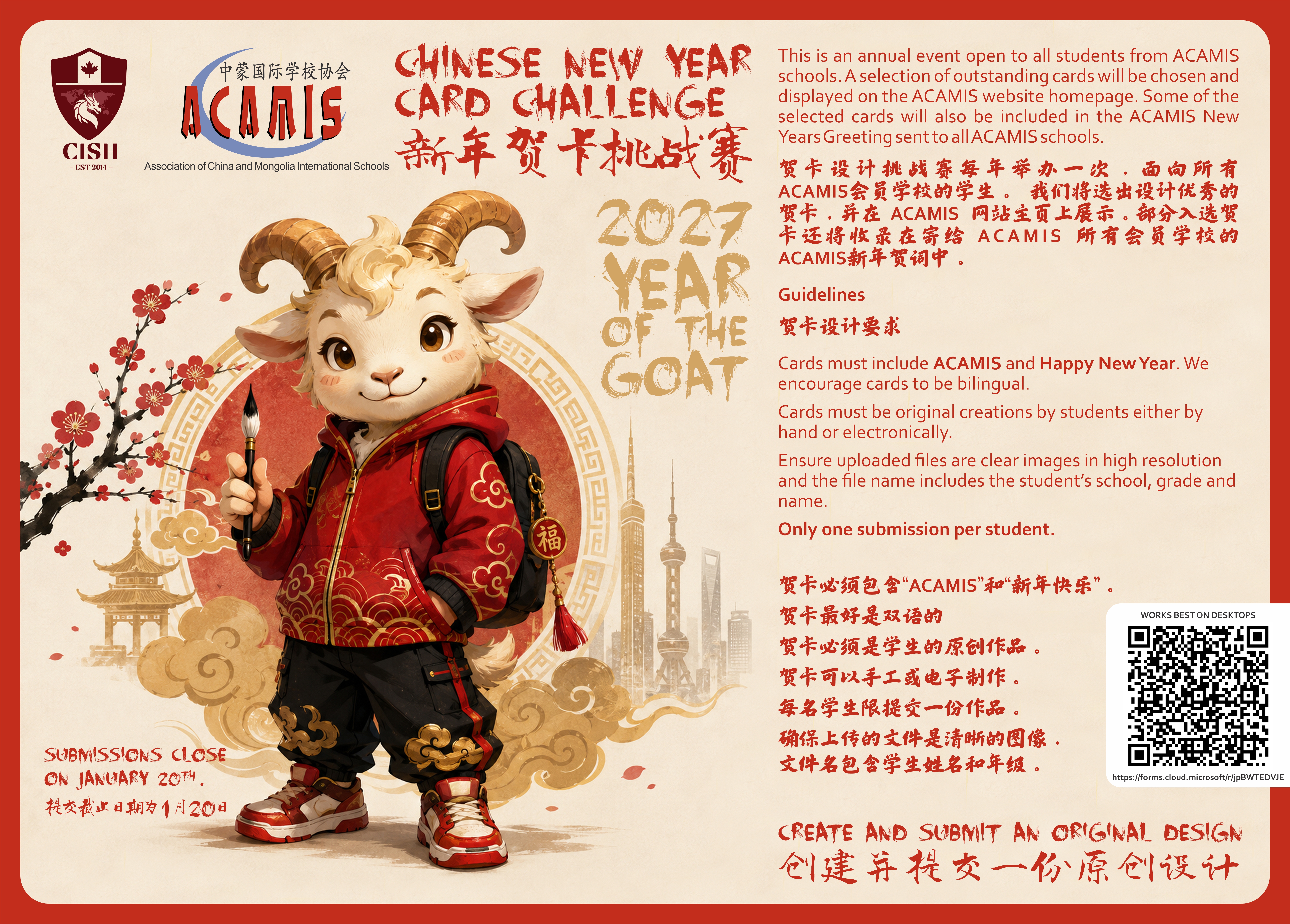
ACAMIS Chinese New Year Card Challenge is an annual event open to all students from ACAMIS schools. Students can submit their creative Chinese New Year cards and take part in a competition for the best selected artworks. A selection of outstanding cards will be chosen and displayed on the ACAMIS website homepage. Some of the selected cards will also be included in the ACAMIS New Year's greeting sent to all ACAMIS schools.
- Target participants: Students from K–12
- Submission platform: Online (Microsoft Forms)
- Judging: Visual Arts and Mandarin educators
- Awards: Certificates of Participation and recognition on ACAMIS channels
Event Information
Important Dates:
- Announcement: Thursday, October 15th, 2026
- Submission Period: Monday, November 1st, 2026 – Wednesday, January 20th, 2026
- Winners Announcement: Monday, March 1st, 2026
- Selected students will receive a certificate of participation
Submission Guidelines
Accepted Formats:
- Images: PNG, JPEG
- Maximum file size: 10 MB
- Recommended resolution: 3500*2500 pixels @ 300 dpi (no upscaling)
Each student may submit only one entry.
Judging & Awards
Judges: A panel of 5 Visual Arts and Mandarin teachers
Awards: Certificate of Participation (digital and printable)
Exhibition: best artworks will be displayed on the ACAMIS website. Host school will organize an exhibition with the best artworks
Judging criteria
Eligibility Check: All cards must first meet the submission guidelines (includes "ACAMIS" and "Happy New Year," is an original student creation, one submission per student, etc.) to be considered.
Originality & Artistic Voice
Does the card demonstrate a distinctive and personal creative idea?
Composition & Visual Impact
Are the imagery, colour, typography and composition effective and engaging?
Process, Effort & Execution
Does the work demonstrate experimentation, development, skill and meaningful artistic decisions?
Response to the Theme
Does the artwork respond creatively to Chinese New Year, the Year of the Goat, and/or aspects of Chinese culture?
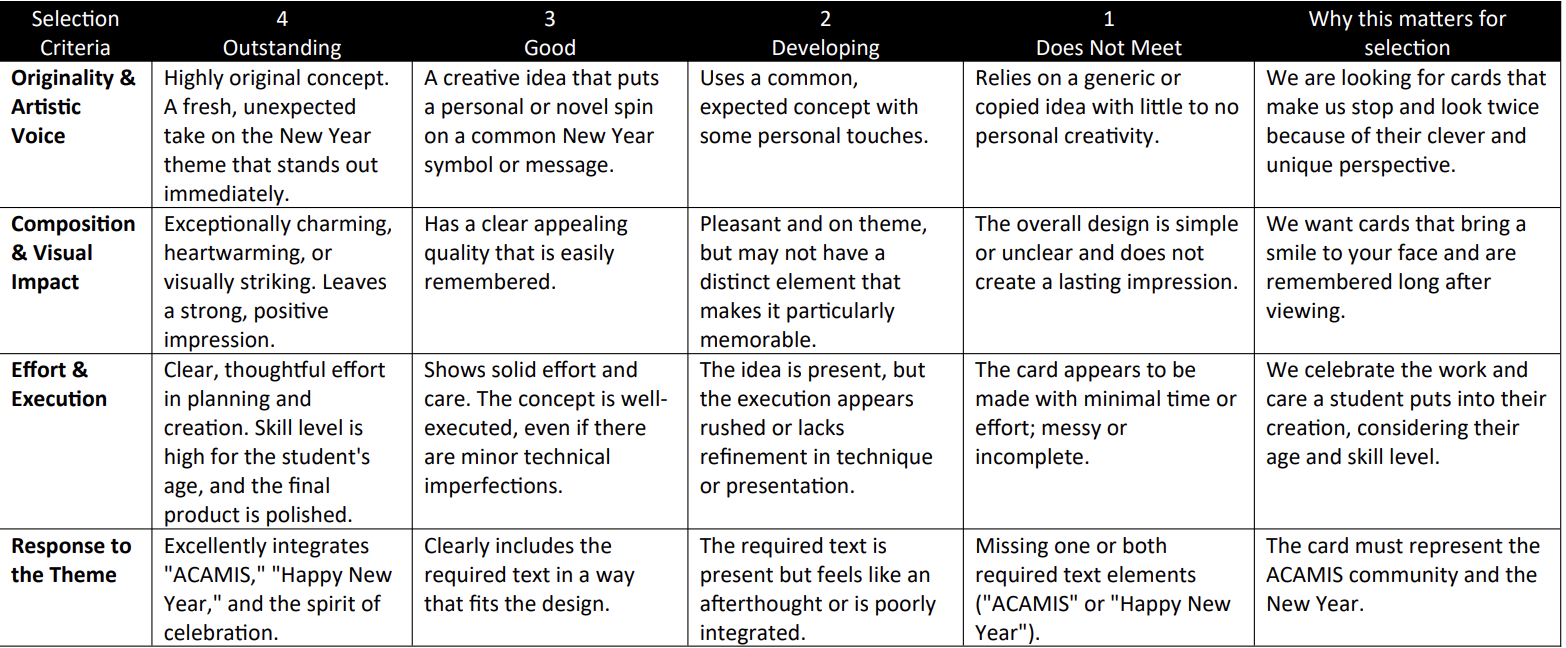
How to interpret the selection criteria:
Cards that are typically selected will score highly in Uniqueness, Visual Impact, and Effort. A card with a very high score in one or two categories can still be chosen, even if its scores in others are average. For example, a incredibly unique and funny card (high "Visual Impact") might be chosen even if the artistic execution ("Effort") is simple.
The most common reasons why a card might not be selected are:
- It does not stand out as unique or memorable among hundreds of submissions.
- It appears to have been created with minimal effort or time.
- It does not clearly include the required text ("ACAMIS" and "Happy New Year").
- The image is blurry, dark, or poorly cropped, making it difficult to see the details.
We celebrate every student who takes the creative risk to submit their work. The selection process is subjective, and with many wonderful entries, difficult choices must be made. This selection information ensures our choices are focused on celebrating creativity, charm, and student effort.
Artificial Intelligence Use and Policy
We recognise that artificial intelligence (AI) technologies are increasingly becoming part of contemporary artistic practice. AI can provide useful opportunities for research, experimentation, ideation and the development of visual concepts. At the same time, participation in the ACAMIS Chinese New Year Card Challenge is intended to demonstrate students’ creativity, imagination and personal responses to Chinese culture and the Year of the Goat. The final card should be an original artwork that reflects the student’s own ideas, artistic decisions and creative effort. The use of AI must therefore not replace the student's artistic authorship or constitute the majority of the creative work submitted as the student's own
AI can support creativity as a tool, but it cannot replace artistic contribution.
PERMITTED AI USE:
- Research Chinese New Year traditions, symbols, imagery and visual styles.
- Explore ideas, themes, compositions and possible visual approaches.
- Develop preliminary ideas or visual references.
- Experiment with possible colour combinations, layouts or imagery.
AI-generated images may be used as references or starting points, but they should not become the submitted artwork. You may transform, redraw, combine, reinterpret or develop AI-generated material as part of your own artistic process. Significant AI use must be disclosed.
NOT PERMITTED AI USE:
- Generate the final card and submit it essentially unchanged.
- Make only minor edits to an AI-generated image and present it as entirely your own artwork.
- Replace your drawing, design, decision-making or creative process.
Participants may be asked to provide sketches, drafts, experiments or other evidence of their creative process, if necessary.